
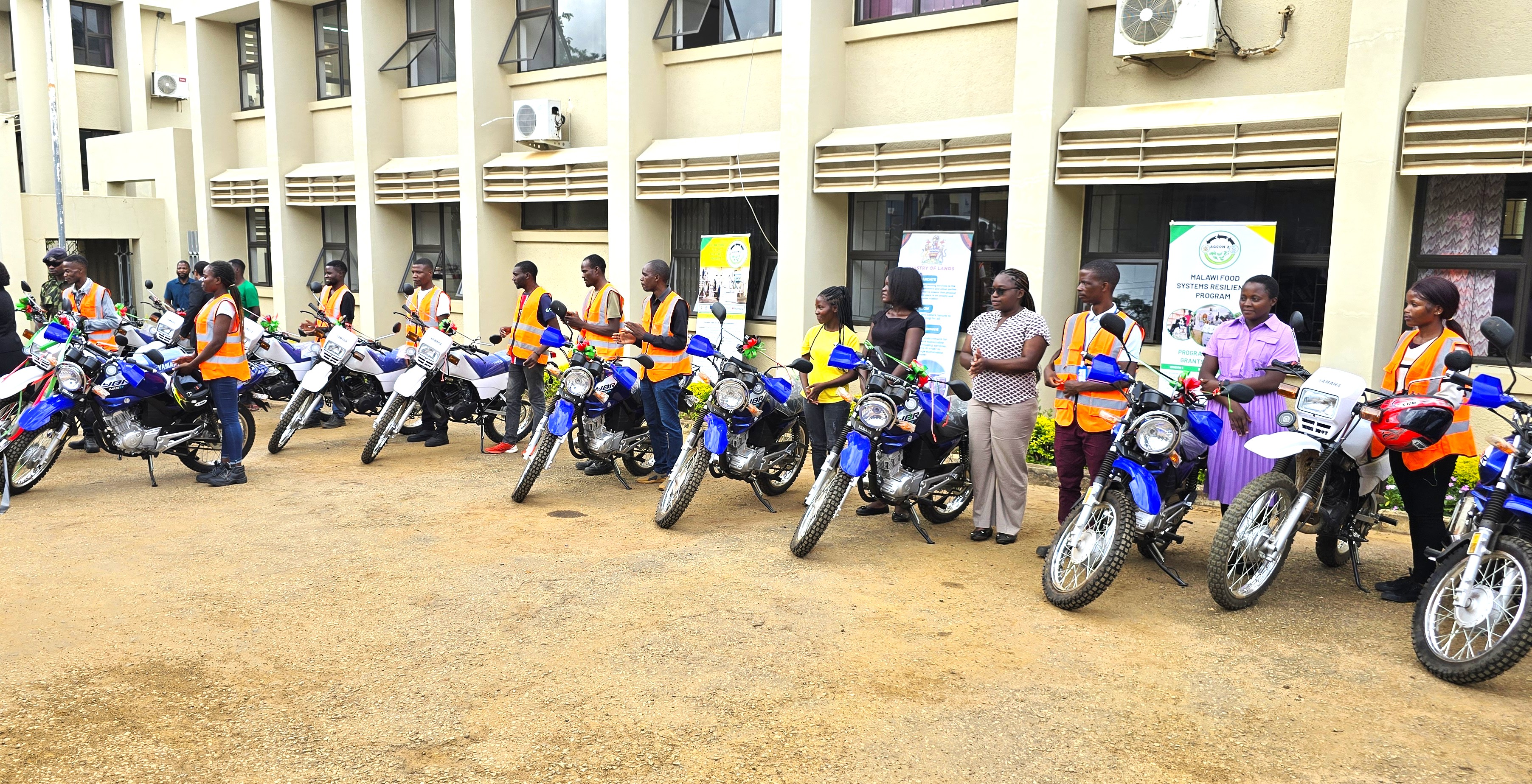
Land clerks standing beside motor cycles
By Enock Chingoni
Across rural Malawi, where dusty roads stretch for kilometres between villages and public transport is often unreliable, land clerks have long faced a difficult mission of reaching farming communities to help secure one of their most valuable assets which is land.
For years, many land clerks travelled on foot or depended on expensive motorcycle taxis to carry out critical responsibilities such as resolving land disputes, maintaining land records and supporting customary land registration.
The challenges slowed service delivery and limited access to communities that urgently needed support. Today, however, that reality is beginning to change.
Through support from the AGCOM 2 Program, 40 motorcycles have been procured and handed over to land clerks across the country, a move expected to significantly strengthen Malawi’s land reform programme and improve access to land administration services at grassroots level.
The intervention, implemented at the request of the Ministry of Lands, Housing and Urban Development, is already being hailed as a major boost to land governance, agricultural commercialization and rural development.
For many smallholder farmers, access to secure land rights is critical for investment, productivity and household stability. Yet achieving that security depends heavily on the work of land clerks operating within Traditional Land Management Areas (TLMAs).
Land clerks play a central role in implementing Malawi’s land reform agenda. Their responsibilities include maintaining land transaction registers, supporting land adjudication and registration exercises, offering technical guidance to land committees, monitoring compliance with land laws and assisting with land use planning under the Physical Planning Act of 2016.
In many rural areas, they are the first point of contact between government institutions and farming communities on land-related matters.
Speaking during the handover ceremony in Lilongwe, Minister of Lands, Housing and Urban Development Honourable Chimwemwe Chipungu described the motorcycles as both timely and transformative.
“Land clerks are instrumental in the land registration process at the TLMA level across districts,” said Chipungu. “The implementation of land reforms, especially the registration of customary land, marks a historic shift in land governance in Malawi.”
He added that secure land registration is helping provide communities with legal assurance over their land rights while laying the foundation for long-term investment and economic development.
The Ministry of Lands, Housing and Urban Development has already recruited and deployed 312 land clerks to district councils nationwide to strengthen land administration services at grassroots level.
However, limited transportation remained one of the biggest obstacles affecting their effectiveness.
“The motorcycles are recognition of the vital role land clerks play in driving development,” Chipungu said. “They are managing records, offering technical guidance and working closely with Customary Land Committees and Tribunals in communities.”
With improved mobility, land clerks are now expected to respond faster to community needs, reach remote villages more efficiently and strengthen communication between district authorities and rural communities.
The motorcycles are also expected to accelerate customary land registration exercises currently underway in several districts under AGCOM 2 support.
Chipungu commended AGCOM 2 for responding to the Ministry’s request, saying the intervention would help strengthen tenure security for thousands of smallholder farmers across Malawi.
“This support will improve service delivery and help communities access land services more effectively,” he said.
Dr. Teddie Nakhumwa is the AGCOM 2 National Programme Coordinator. He emphasized that land reform is a critical pillar in Malawi’s agricultural commercialization agenda.
According to Dr. Nakhumwa, secure land tenure creates confidence among farmers and encourages long-term investment in agriculture.
“Without clear and recognized land rights, farmers face uncertainty and limited opportunities to invest,” he explained. “That is why we responded swiftly to support this initiative.”
He noted that land clerks have played a major role in facilitating customary land registration for members of producer organizations supported under AGCOM 2 and other agricultural programmes.
By strengthening land governance systems, the programme is helping create an enabling environment for agricultural investment, food systems resilience and rural economic growth.
“When farmers feel secure on their land, they are more willing to invest in irrigation, tree planting, soil conservation and other productivity-enhancing activities,” Dr. Nakhumwa said. “That contributes directly to agricultural transformation.”
For district councils, the motorcycles are expected to dramatically improve efficiency and outreach.
Rosemary Nawasha welcomed the development, saying transportation challenges had previously made it difficult for land clerks to access some communities.
“In many cases, land clerks had to walk long distances or rely on informal transport such as motorcycle taxis to carry out their duties,” Nawasha explained.
She said the motorcycles would enable officers to reach hard-to-access areas more consistently and improve the speed at which land-related services are delivered.
“This support will help strengthen service delivery and improve coordination with communities,” she added.
The provision of motorcycles may appear simple, but for communities waiting for land services, the impact could be far-reaching.
Improved mobility means faster land registration, quicker resolution of disputes, better monitoring of land transactions and stronger engagement with rural communities.
For thousands of smallholder farmers, it also means greater access to secure land rights which are a foundation that supports agricultural commercialization, investment and economic empowerment.
The initiative reflects AGCOM 2’s broader vision of building resilient food systems and transforming rural livelihoods through strategic investments that remove barriers to development.
As motorcycles begin moving across Malawi’s rural roads carrying land clerks to remote villages, they are doing more than transporting officers.
They are carrying opportunity, security and the promise of a more inclusive and efficient land governance system for farming communities across the country.
- 1 view