By Alick Ponje and Mark Ndipita
Every morning and evening, long before the bustle of business begins at Goliati Trading Centre in Thyolo, streams of farmers emerge from surrounding villages carrying milk churns and buckets of fresh milk balanced carefully on bicycles, motorbikes and shoulders.
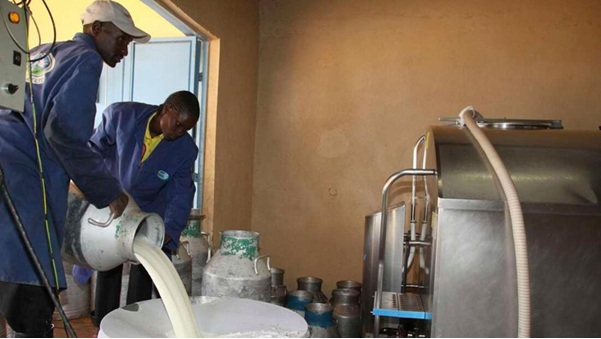
At the centre of this daily movement is Mwala Wolemba Milk Bulking Group in Traditional Authority Chimaliro, where milk is weighed, tested, recorded and poured into a cooling tank before collection by Lilongwe Dairy.
What appears to be a simple routine has quietly become the heartbeat of a growing rural enterprise that is transforming livelihoods for hundreds of farming households.
Behind every litre delivered lies a story of resilience, cooperation and determination by 219 smallholder farmers who are proving that dairy farming can be more than subsistence survival and it can be a pathway to wealth creation, household food security and commercial success.
The journey of Mwala Wolemba Milk Bulking Group began modestly more than a decade ago as a small milk bulking arrangement supplying milk to a private company.
Back then, the group had limited infrastructure, few dairy animals and little experience in operating as a structured agribusiness enterprise.
“A programme approached us and asked us to identify land where a dairy facility could be constructed. The project was completed in 2012,” recalls group member Emmanuel Vimbani.
Since then, the enterprise has steadily evolved into an organised and commercially driven dairy business.
Today, individual farmers deliver milk separately, but all volumes are centrally weighed, recorded and marketed collectively. Payments are made according to each farmer’s contribution, a system members say has strengthened accountability, transparency and trust within the group.
The approach has also helped farmers understand the value of working together.
“We now see dairy farming as a business and not just farming for home consumption,” says Vimbani. “As members, we buy cattle feed together and also participate in village savings and loans schemes to strengthen our economic lives.”
By pooling resources and purchasing inputs collectively, farmers are reducing costs while increasing production efficiency and income stability.
Support from the Agriculture Commercialisation (AGCOM 2) has further accelerated the group’s transformation.
Implemented with support from the World Bank and other development partners, AGCOM 2 is promoting agricultural commercialisation by strengthening value chains and linking smallholder farmers to profitable markets.
Under the programme, Mwala Wolemba Milk Bulking Group has secured a K282 million grant aimed at expanding milk production through the purchase of 130 dairy cattle and construction of improved kraals.
The first tranche has already financed the purchase of 65 dairy cattle, directly benefiting half of the 130 members who registered for the support.
“We applied after seeing the AGCOM call for concepts because we wanted to increase the number of dairy cattle among our members,” Vimbani explains. “The first tranche has already been disbursed, and we are excited about the progress we are making.”
Members themselves also contributed towards the project through financial and in-kind contributions, demonstrating commitment and ownership of the initiative.
“We fulfilled all the contribution requirements that were needed from us,” says Vimbani. “Everyone is determined to see this project succeed because we know it can transform our lives.”
For many households, the additional dairy cattle represent far more than livestock. They symbolise expanded income opportunities, improved nutrition and greater economic security.
Despite rising milk production, the farmers continue to face one major challenge which is low milk prices caused by oversupply and limited processing capacity.
Like many smallholder dairy farmers across Malawi, members often struggle to maximise profits from raw milk sales alone.
But instead of giving up, the group is already looking ahead.
Members are now pursuing value addition as a long-term solution to increase profitability and strengthen resilience within the dairy value chain.
“We want to move away from depending only on raw milk sales,” says Vimbani. “That is why we are pushing for milk processing so that we can produce finished dairy products and earn more profit.”
The group is planning to establish processing facilities and acquire cooling and manufacturing equipment to support future production of yoghurt, sour milk and other dairy products.
“We need a processing factory and modern cooling machinery,” Vimbani explains. “The good thing is that AGCOM has promised to continue supporting us as we grow.”
The planned investment is expected to improve market competitiveness while creating additional jobs and business opportunities within the community.
For farmer Edna Phwete, dairy farming has been a gradual journey built on patience, determination and smart investment.
She started with tomato farming before slowly reinvesting profits into livestock production.
“We bought a bull, sold it and later bought a cow. That was the beginning of our dairy farming journey,” says Phwete with a smile.
Today, she sees dairy farming as one of the most reliable sources of household income and nutrition.
“With this support and training, we believe our family welfare will improve greatly,” she says. “The cows will strengthen our business and help us build a better future for our children.”
Phwete says participation in village savings and loans schemes has also helped her household become more financially stable.
She is already preparing for expansion and understands that proper feeding is essential for high milk production.
“I already have some experience, but I also know that a cow only gives milk according to how well you feed it,” she says. “Good feeding means better milk production and better income.”
Beyond income generation, dairy farming has improved nutrition for many households while also providing manure for crop production at a time when fertiliser prices continue to rise.
According to Phwete, manure from dairy cattle is becoming increasingly valuable for improving soil fertility and reducing dependence on expensive chemical fertilisers.
As the enterprise grows, members are also preparing to transition into a fully registered cooperative to strengthen governance and improve business operations.
Henry Chimpesa, who facilitated AGCOM-supported training sessions for the group, says members are being equipped with knowledge on governance, cooperative operations and legal requirements.
“They need to understand what it means to belong to a cooperative, how cooperatives operate and how they are established,” Chimpesa says.
The training covered governance structures, member rights and responsibilities, financial accountability and legal frameworks under the Cooperative Act.
According to Chimpesa, formal registration will allow the group to enter legally binding contracts, own assets and access wider institutional and financial support.
“To attain legal capacity to enter binding agreements with buyers and suppliers, they need legal entity status through registration,” he explains.
The group’s secretary, Phillip Kaliwo, says the training has already strengthened unity and discipline among members, especially in financial management.
“We are learning how to work together and manage money properly because financial issues can easily create misunderstandings,” Kaliwo says. “The training is helping us build trust and cooperation.”
For the farmers of Mwala Wolemba Milk Bulking Group, dairy farming is no longer simply about selling milk. It is about building a sustainable business capable of uplifting entire households and communities.
Their story reflects the broader vision of AGCOM 2 which is transforming smallholder farmers into commercially oriented producers linked to structured markets and value-added opportunities.
As milk continues to flow into the cooling tank each morning and evening at Goliati Trading Centre, so too does a growing sense of optimism.
For these farmers in Thyolo, every litre delivered represents more than production. It represents progress, dignity and the shared dream of building a stronger rural economy through commercial agriculture.
- Add new comment
- 3 views
Comments
Mwala Wolemba Milk Bulking…
Mwala Wolemba Milk Bulking Group