
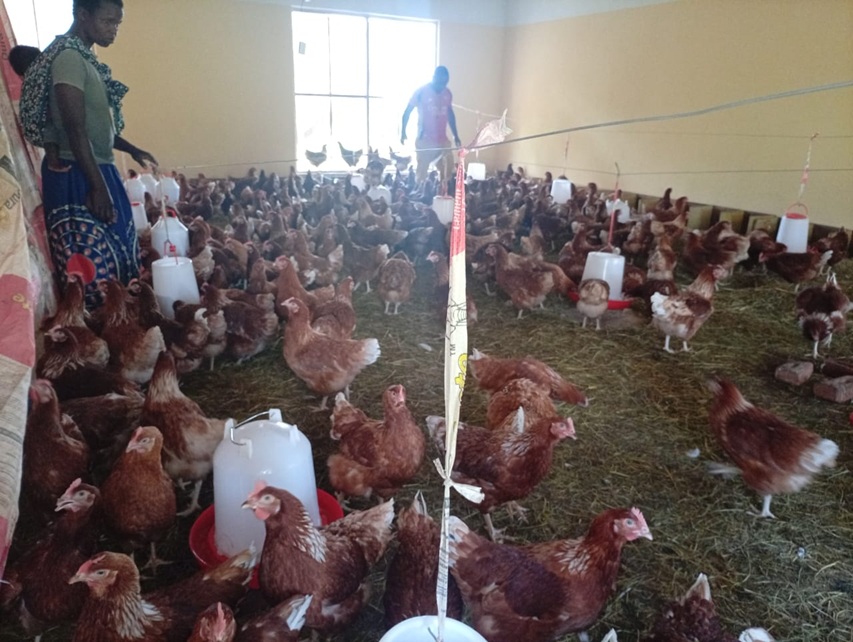
A member of the cooperative feeding poultry
By Fair James Mpinganjira and Mark Ndipita
In the rolling hills of Neno district, a huge transformation is taking place. What began as a small village savings and loans group for women has now evolved into a thriving poultry enterprise with the potential to generate more than K2 million every week from egg sales alone.
For the women of Makina Poultry Producers and Marketing Cooperative in Neno, the journey represents far more than business growth. It is a story of resilience, empowerment, commercialization, and renewed hope for rural women farmers under the Agricultural Commercialization (AGCOM 2) Program.
Located at Chifenthe village in Traditional Authority Chekucheku, the all-women cooperative is steadily becoming a shining example of how AGCOM 2 is transforming subsistence farming groups into commercially viable agribusiness enterprises capable of contributing to Malawi’s long-term development agenda.
Makina Cooperative traces its roots to a village savings and loans association formed by women determined to improve their livelihoods and provide better futures for their families.
In April 2024, the group joined AGCOM 2 and embarked on a remarkable journey toward agricultural commercialization. Through technical support, business development training, and cooperative strengthening initiatives under AGCOM 2, the women were trained and formally certified as a cooperative.
Today, the cooperative boasts 55 active women members, including 23 young women and youth participants, a development that has significantly increased women and youth participation in agribusiness in Neno district.
Chairperson of the cooperative, Esther Subili, says AGCOM has completely changed the women’s outlook on farming and business.
“Before AGCOM 2, many of us only depended on small-scale farming and village savings. We struggled to earn enough income to support our households. Today, we are proud business women running a commercial poultry enterprise that is changing our lives,” said Subili.
Through AGCOM 2 support, Makina cooperative received a K96.3 million matching grant aimed at improving livelihoods through poultry production and egg marketing.
Using the grant, the cooperative has constructed a modern poultry house, installed drinkers and feeders, built sanitation facilities, and procured 550 point-of-lay chickens for commercial egg production.
The chickens have started laying eggs, with the cooperative currently producing an average of 18 trays per day. At the current market price of K16,000 per tray, the cooperative expects to generate approximately K288,000 daily, translating to more than K2 million per week and over K8.6 million per month.
Secretary for the cooperative, Beatrice Chikhosi, says the women are optimistic about the future of the business.
“We never imagined that one day we would operate a business capable of generating millions of Kwacha every month. AGCOM 2 has given us the confidence, skills, and resources to participate meaningfully in commercial agriculture,” she explained.
She added that the cooperative’s long-term target is to produce and sell at least 4,000 trays of eggs annually, potentially generating over K60 million in annual revenue.
Beyond the impressive income projections, the project is already delivering social and economic benefits to members and the surrounding community.
In many rural communities, women often have limited access to productive resources and commercial opportunities. However, Makina women cooperative is demonstrating how targeted investments in women-led agribusinesses can improve household welfare and community development.
Members of the cooperative say the anticipated profits from egg sales will help families afford better food, pay school fees, access healthcare services, and improve housing conditions.
Subili believes the project will also help reduce gender-based violence and economic dependency among women.
“When women are financially empowered, families become more stable. Women are able to contribute to household needs, support their children’s education, and participate in important family decisions. This project is restoring dignity and confidence among women in our community,” she said.
The cooperative also expects the business to improve child nutrition through increased access to eggs and higher household incomes.
As part of its operations, Makina cooperative has already employed two full-time security officers and anticipates creating additional jobs as production expands.
The enterprise is also expected to benefit surrounding farming communities through the sale of poultry manure, which many farmers can use as an affordable alternative to expensive chemical fertilizers.
With fertilizer prices remaining high for many smallholder farmers, poultry manure is expected to help improve soil fertility and increase crop yields in the area.
Chikhosi says the cooperative wants the business to become a model for sustainable rural entrepreneurship.
“This is not only about selling eggs. We want to create opportunities for other women and young people in our community. As the business grows, more people will benefit through employment, markets, and access to organic manure for farming,” she said.
Makina cooperative’s success story reflects AGCOM 2’s broader objective of transforming Malawi’s agriculture sector from subsistence farming into commercially oriented agribusinesses capable of generating wealth, jobs, and economic growth.
By empowering women farmers with financing, skills development, and market-oriented production systems, AGCOM 2 is helping rural communities become active participants in Malawi’s economic transformation agenda under Malawi 2063.
For the women of Makina cooperative, the poultry enterprise is more than a business venture, it is a symbol of possibility.
What started as a simple village savings group is now emerging as a powerful women-led agribusiness capable of changing lives, strengthening communities, and inspiring a new generation of rural entrepreneurs in Neno district.
- 466 views